
STUDENTS PLAY THE TRUMP CARD

January 31st, 2012

Dear Friends,

Imagine a luxuriant indoor garden nestled into an 89th floor penthouse in Chicago’s iconic Trump Tower. That lush botanic vision is among the dynamic design elements a Harrington College of Design student used to capture a $1,000 first prize in a competition sponsored by John Robert Wiltgen Design, Inc. The winner is Chicagoan Arthur Garcia-Clemente, 29, now completing work for a master’s degree in interior design at Harrington.

in September designer John Wiltgen, the leader of an acclaimed team creating award-winning vertical living spaces at Trump and elsewhere throughout the US and abroad, invited students in Harrington’s Competition Studio class to submit a rendered space plan for 14,000 sq. ft.  at Trump Tower. With 16 ft. ceilings, the raw, unfinished area is rumored to be a possible Chicago home for “The Donald.’’ The assignment required a space plan and a 3-D color illustration to showcase the students design concepts.

Wiltgen, a 30-year veteran designer, is a professional member of the International Interior Design Association (IIDA). Calling it a once-in-a-lifetime opportunity for students to work in a surreal space he acknowledges the level of luxury living near the peak of Trump Tower as beyond the realm of many, though it is the real world for a privileged group.

“This project was a unique opportunity for students to see and work in that world,’’ says Wiltgen.

In December, Garcia-Clemente and 15 other students presented their work to three judges: Sara Martens, Trump Tower’s executive director; Mitch Obstfeld, publisher of I 4 Design Magazine; and John Robert Wiltgen. Obstfeld is a member of Harrington’s board of trustees.

Second prize winners were Ann Erskine and Nick Gabriel of Chicago who shared a $750 prize. Oak Park resident Elizabeth Neuffer finished third and received $500. The three are slated to receive bachelor’s degrees in interior design from Harrington in 2012.

The size, volume and scale of the Trump space represented a major challenge. “Humanizing’’ the space – organizing it into galleries, each dominated by windows with dramatic, world class views and an abundance of natural light was Garcia-Clemente’s solution for taming those obstacles.

“This is the first opportunity I have had to challenge myself to think of an entire space – floor, ceiling and walls,’’ said Garcia-Clemente who integrated a strong traditional design concept within Trump’s ultra contemporary environment. In announcing the award, Wiltgen praised the winner’s renderings and reflected ceiling plan which he said helped the judges envision the finished space.

“Interior designers do not sell furniture and/or furnishings – we sell style. You proved that you get that,’’ Wiltgen told Garcia-Clemente, for whom interior design is a second career after earning  a  degree in economics at Duke University, Durham, NC, and working in the corporate world until he realized how much he missed siren call of art which had dominated his earlier life.

Labeling the Trump project a challenge to any professional, Harrington instructor Constantine Vasilios believes participation by Wiltgen and Trump’s Sara Martens raised the stakes for competitors. “The results are testimony to the students intellectual rigor, discipline and design skills,’’ Vasilios said. Mitch Obstfeld agrees saying he is “ simply amazed at the quality and creativity all of these students exhibited in their design concepts for Trump.’’

While students Ann Erskine, 21, and Nick Gabriel, 24, knew each other casually, they had never worked together until Harrington instructors urged them to collaborate on the Trump project, citing the strength and similarity of their work. After having captured second place in the competition, they now have difficulty not working in tandem. For the competition, the pair opted for a classic traditional design concept, introducing strong dramatic elements to make it work effectively in the contemporary Trump setting, relying on classic symmetry to organize a basically asymmetrical space.

Third place winner Elizabeth Neuffer chose also to strike a balance between modern and traditional styling, ultimately opting for a timeless, universal look she considers appealing to a variety of design preferences. While her influence was strictly classic, her finished product offered slightly more contemporary vibe than that of her peers. Neuffer took care to ensure that rooms used for active living and entertaining are open spaces while bedrooms and other leisure space are more privately grouped.

Harrington officials are planning an early 2012 exhibit of these student projects. For information, contact Constantine Vasilios, Harrington College of Design, 312-697-3170 or cvasilios@harrington.edu.

———————————————————————————————————————

John Robert Wiltgen, a professional member of  IIDA, is the principal and CEO at John Robert Wiltgen Design, Inc., 70 W. Hubbard St., Suite 205, Chicago, IL. 60610-4675, 312-485-1151 or john@jrwdesign.com

TRUMP TOWER TWO BEDROOM

November 14th, 2011

Dear Friends

Who doesn’t love adventure?

An adventuresome young Chicagoan recently visited Africa where he and his brother “camped’’ on the roof of an SUV to avoid becoming a midnight snack for lions, tigers and other hungry wildlife. That  audacious spirit also emerged when he chose to establish his own first home at Trump Tower Chicago – an enterprising decision for one barely a quarter of a century old. Aware of  the JRW Design’s reputation for producing award-wining homes in luxury residential towers across the US, commissioning us to make that happen for him carried far less risk.

As a child, he traveled the world with his parents, lived in several foreign countries and cultivated a sophisticated taste level – which he knew we would  creatively interpret . And interpret we did, a process greatly simplified by the proximity of our atelier to Trump Tower. With many clients in Chicago’s newest landmark, we run back and forth two and three times daily meeting clients and vendors, inspecting work in progress, accepting deliveries and many other design/build related responsibilities. The Donald couldn’t have built Trump Tower much closer to us…it’s a mere three blocks away.

The building’s standard finishes were all in place when our client closed on the 2,000 sq. ft., two bedroom condo, then handed us the key and departed for another continent on a year-long business assignment. With his approval, we established a warm, rich, brown and copper-toned color palette to compliment  what already existed. And it suited the owner’s Trump Tower lifestyle. Carpet and draperies softened the hollow echo created by floor to ceiling windows, wood flooring and other hard surfaces.

A cocktail table’s organic form and sleek finish softens the geometry of the interior architecture. Because the 10-foot  ceilings are concrete, the only way to install recessed lights is to lower it 6 inches so instead we used swing arm lamps and a back lit mirror to illuminate the space.  To totally integrate art with the architecture and design, we found an original framed Picasso which quietly overlooks the dramatic setting.

Unusual textures merge in the master bedroom to create an urban oasis. Highly polished goatskin-clad nightstands flank a contemporary-styled bed. The large, wood-framed piece was French polished to achieve a more metropolitan countenance in keeping with its new high-rise home. Bronze wall mounted swing arm lamps allow room for personal effects on top of the chests. The contemporary occasional chair is a combination of ultra suede and mahogany.

With the impeccably clad young business man in mind, we scuttled the existing closets to create a new, more upscale design for the master bedroom’s built-ins – an arrangement that far better suits his suits and other apparel. The owner possesses a distinctive sense of style. While business, not acting, is his forte, he could very well portray a young James Bond.

We also relocated a wall helping to ease the second bedroom into a den/guest room. The renovation actually worked to capture additional space we utilized for a custom-designed built-in desk, bookshelves, flat screen TV, computer and other electronic entertainment equipment.

Creating a stylish home that meets the personal and social needs of a young business man resulted in our firm being awarded a “second generation’’ project in the owner’s family. His parents were so impressed with our in-town achievement they commissioned us to redesign elements of their home in the suburbs. In itself, that was a delightful and welcome compliment.

May your world be beautiful.

John Robert Wiltgen

John Robert Wiltgen, Professional member IIDA

© 2011 John Robert Wiltgen Design, Inc. All rights reserved.

JOHN’S BATH BLOG

August 16th, 2011

Dear Friends,

Who doesn’t dream about the spa-like luxury of a beautiful, private bath – a welcome retreat from the harsh reality of day-to-day living?  You don’t need to build a brand new nest to achieve that. Creating over the top bespoke bath suites and remarkable powder rooms – whether in absolute new construction or as part of an innovative remodel – is a specialty John Robert Wiltgen Design perfected long ago. In our three decades of experience, we have masterminded some amazing creations. Join us in an inspirational tour of a few of our favorites…

There’s more humor than meets the eye in a bathroom where lighthearted spirit makes a strong impression. Newspaper comic strips were pressed into action as wallcovering before being glazed, then superimposed with Picasso-like images. A random smattering of colorful wall tiles compliments the wall treatment.
The design of the intricate mosaic marble pattern on the ceiling and walls of a Roman-inspired bath took weeks of our  time to complete. Part of an interior renovation, it is one of three and one-half new baths we created in the penthouse of 1550 N. State Parkway, a circa 1913 Beaux Arts building in Chicago. Artisans hand-cut each tile to fingernail size to achieve the distinctive Byzantine pattern.
Our dramatic, fully appointed master bath suite adds an appropriate current touch to a residence we designed as a reinterpretation of one of the historic homes that belonged to some of Chicago’s prominent pioneer families on historic Prairie Avenue. We eliminated a proposed study to capture space for this elegant retreat and paneled the tub apron to allow easy access to its mechanics.
The delicate balance of ivory tones synthesizes with Crema Marfil drawing the eye to a 1,700 year old Turkish stone mosaic a penthouse owner has prized for years. To maximize the feeling of space, we integrated the shower pan and tub and chose cold cathode lighting to illuminate the perimeter of the dropped ceiling resulting in an ethereal glow throughout the setting.
In Los Angeles we sacrificed a sitting room adjacent to the master bedroom to achieve a sybaritic, minimalist spa in a classic Hollywood bungalow frequently leased furnished to high-profile visitors. The soaking tub was installed beneath the limestone floor to maximize the views of the surrounding rambling garden and enhance the zen-like setting.
As with every project, each detail of a shimmering powder room originated in our minds long before construction began. From the ingenious art of the exceptional white gold light fixture to the framed Picasso on the wall to the total absence of water supply and drain, the setting is a virtual jewel box tucked artfully into a Trump Tower Chicago residence.

When it comes to the 21st century bath scene, our vision is limited only by our clients’ desires. We are forever eager to combine your dreams with emerging technology and the latest products to produce the most amazing results.

You’re invited to share with us your dreams of a sensuous, luxury space. We will create a way to turn them into reality.

In our next blog we will share with you our latest ideas for a truly chic and stylish residence in the newest building to grace Michigan Avenue.

Best Regards,

John Robert Wiltgen

John Robert Wiltgen, Professional member IIDA

© 2011 John Robert Wiltgen Design, Inc. All rights reserved.

STAIRCASES

June 10th, 2011

Dear friends,

My 30 year adventure in the world of design has been an upward climb.  Quite literally during this time, the JRW design team has created many beautiful staircases for some of our more comprehensive commissions.  While all may not lead directly to heaven, we think they certainly look the part.

Stairways are as much a work of art or sculptural centerpiece as a functional element of the architecture.  I want to share with you some of our memorable favorites.

A hand-carved spiral staircase sweeps residents and their guests to the three other floors of a turn-of-the-19th century residence located in Chicago’s DePaul neighborhood.  The flight of stairs was detailed to look as if it had always belonged to this elegant home even though we had it made for a recent renovation of the property.  This home has an elevator and six stairways—three interior and three exterior.
The dramatic stairway’s crisp, straightforward styling creates a hip, contemporary vibe that reflects the lifestyle of an active young suburban family.  As clients and friends of our award-winning design team for the past 15 years, we have watched their children grow from infants tentatively learning to climb those stairs to vivacious teenagers scaling them two at a time.
Connecting a great room to a duplex loft’s master suite, new lumber was manipulated – distressed, stained and glazed – to perfectly resemble the existing timber in a converted circa 1917 harness factory.  The result: a lean, spare staircase that introduces straightforward flair as an important detail in a warm, inviting home.
We created this staircase to look exactly as it would have appeared in the 1880s for the model for the Mansions on historic Prairie Avenue.  The big chunky newel post, stained handrail and paneled apron made this brand new home look like a renovation of a landmark property.
Circular iron stairs wrap sensuously around the stuccoed elevator penthouse of a vintage Second Empire-style home.  They create a sense of mystery as they link to a private Juliette balcony overlooking the fourth floor rooftop garden and third floor solarium.  We are just putting the finishing touches on this exterior redo NOW.

Stairs.  Staircase.  Flight of stairs.  However you want to refer to them – they are just one of many ways to make your world beautiful.

Enjoy,

John Robert Wiltgen, Professional Member IIDA

POOL PAVILION

March 23rd, 2011

Dear friends:

Welcome spring! For each of the 30 years of our design practice, we have joyously embraced this promising season – a time when nature re-invents itself in a dazzling makeover as our clients rejoice in the creation of dazzling outdoor living spaces in the most amazing places. Urban terraces overlooking the hustling city, a peaceful patch surrounding a lovely home or the terraced landscapes of a majestic estate, we always anticipate the long awaited season in the sun.

Now welcome 2011 – the year that takes us to the most amazing outdoor space ever. Our assignment: create a pool pavilion with entertaining, lounging, pool and fitness rooms in a climate where temperatures range between 75 to 90 degrees year round with an average rainfall of 120-inches.

The result is a spectacular synthesis of outdoor and indoor space, a serene and elegant retreat, perfectly suited to the site with panoramic views of the lush courtyard gardens.  Navona travertine from Italy was selected for both the interior and exterior of this 5,750 sq. ft. pavilion.  A picturesque waterfall provides a soothing symphony of sound as it re-circulates the water for a 750 sq. ft. pool, and an oversized skylight protects the space during the rainy season.  Additionally, a state-of-the-art fitness center occupies the upper level and overlooks this beautiful scene.

In the adjacent lounge, furnishings of teak, natural tree trunks and durable, all weather fabrics meld glamour with comfort and practicality.  This area is dedicated to use by family and friends, as well as for entertaining V.I.P. guests. Graceful lengths of outdoor fabric billow from glass-free openings, allowing breezes to flow through the space, and a fresh color palette nods gracefully to the pavilion’s verdant site. We predict this will become the estate’s most intimate, yet popular area.

The pavilion’s sleek kitchen sports Viking cabinets and appliances manufactured for outdoor use. The countertops feature recycled glass chips embedded in polished concrete – an environmentally-friendly material that is well-suited to the equatorial climate. The bar stools feature a motif of trees springing upright – yet another bow to nature that adds a lacy texture to this chic setting.

Designing successful architecture for a steamy, sultry climate offered some exciting challenges that required innovative solutions. It is a thrilling project that has inspired John Robert Wiltgen Design to showcase our potential and to envision the creation of more amazing spaces in the future.

Tropics or not, how cool is this?

John Robert Wiltgen, Professional Member IIDA

CHICAGO DIABETES PROJECT (CONTINUED)

March 17th, 2011

Dear Friends,

This is a remarkable story…

It’s been two years since Sandy Alvord has needed prescription insulin to control her blood sugar levels.  More than three years have elapsed  since Suzi Johnson threw away her insulin pump and started living her life as a cured diabetic.

Both women participated in the Chicago Diabetes Project (CDP), a global research study whose goal is providing a “functional cure’’ for diabetes, a debilitating disease which is the world’s leading cause of death.  Pancreatic islet cell transplants, received at the University of Illinois at Chicago, enabled these women to stop taking prescription  insulin.  The procedure was done under the supervision of Jose Oberholzer, M.D., CDP’s director. He is a professor of surgery, endocrinology, diabetes and bioengineering at UIC and directs a panel of 13 scientists from three continents participating in the program.

Transplant patients Alvord and Johnson told their stories at a recent benefit dinner for the Chicago Diabetes Project at Accanto, a restaurant in Chicago’s Logan Square neighborhood known for its World class Italian cuisine. The menu for the remarkable seven course gourmet repast was designed by internationally-acclaimed Michelin star-rated Chef Domenico Acampora, himself a diabetic. The event was underwritten totally by Accanto’s owners Maria and Giovanna Rubino.

Raising awareness of the perils of diabetes and the importance of developing an effective cure for this disease which is likely to affect more than 300,000,000 people across the globe by 2025 was my reason for organizing this event. Dr. Oberholzer updated guests on progress of CPD’s work and answered their questions.

“The mission of CDP is to make islet cell transplantation today’s most promising treatment for diabetes and a viable option for all who suffer  the disease,’’ Oberholzer told the group. “We are now able to provide a `functional cure’ on a limited basis, however, we hope to be able to generate an unlimited supply of insulin-producing islet cells to make this treatment available to all who have been afflicted with Diabetes.”

Transplanted cells stimulate insulin production and regulate glucose levels. In 53-year-old  Suzy Johnson’s case, the cells began producing insulin the evening of the day of her transplant. Within three weeks she was able to disconnect her insulin pump and begin living the life she was forced to abandon more than 20 years earlier. She was diagnosed at 30, an advanced age for the onset of Type 1 diabetes.

It took Sandy Alvord, whose diabetes was diagnosed when she was 6, a little longer to kick the insulin habit. Her first two cell implants failed but the third worked like a charm.

While both patients currently take immunosuppressants, current research is being done on an encapsulation process that may make anti rejection drugs unnecessary.

While CPD is within arm’s length of achieving its goal, the remaining research needs to be advanced at a quicker pace – something that takes money.  While the study receives some government and other public funding, private donations are welcome.

For more information about CPD and how to help support this vital research, visit www.chicagodiabetesproject.org or phone 312-996-6771 and thank you to those of you who have given so graciously.

John Robert Wiltgen, Professional Member IIDA

CHICAGO DIABETES PROJECT

January 6th, 2011

Dear Friends,

Happy New Year.

I am asking for help with one of my New Year’s resolutionsaiding the Chicago Diabetes Project research to find a cure for Diabetes. Currently I am developing a mailing list for a February fundraiser and need names and contact information for potential patrons interested in learning, first-hand, about the latest developments.

Think about who you know personally who can help new and amazing research which would replace insulin therapy with pancreatic islet cell transplantation as a universal treatment for diabetes.. Then please send me their names and contact information immediately.

Some 170 million diabetics worldwide live with the many complications including blindness, kidney failure, heart disease and amputations. Diabetes is the number one cause of death by disease. We need to find a cure NOW.

Dr. Jose Oberholzer, chief of transplantation at the University of Illinois College of Medicine, heads an elite team of physicians, molecular biologists, engineers, chemists, and dozens of researchers from four continents that are all working on this cure. Their goal is to increase the efficiency and availability of pancreatic islet cell transplants.

Clinical trials have been underway for several years with some patients remaining insulin-free for as long as 13 years. The therapy uses adult (not embryonic) cadaver cells. However, at present,  patients still must take medications to prevent the rejection of the transplanted, insulin-producing cells,

This  treatment focuses on Type 1 Diabetes and is offered to patients who cannot control their blood sugar by current methods or who fail to recognize when their blood sugar is dangerously low. Islet transplantation is limited by the number of organ donors available and the need for suppressing the immune system to prevent rejection.

However, with the potential availability of an unlimited cell source and avoidance of immunosuppressives, the treatment can be extended to most diabetics – the actual goal of Chicago Diabetes Project. Future islet transplants may consist of reproducible insulin-producing cells that are encapsulated to protect against assault from immune cells, allowing the patient to live with little or no dependence of anti-rejection or immunosuppressive medication.

Islet cell transplantation may represent the single most important medical advance since 1955 when Dr. Jonas Salk perfected the polio vaccine.

I really need your help! Please send me names, e-mail and home addresses of friends and family you believe should attend this most inspirational event.

Thank you. And again, happy new year!!!

John Robert Wiltgen, Professional Member IIDA

MAY YOUR WORLD BE BEAUTIFUL

December 15th, 2010

Dear Friends,

As 2010 draws to a close it marks the 30th anniversary of the founding of John Robert Wiltgen Design. Thank you to all our clients, friends, and family who have helped make this possible. We could not have accomplished all that we did without the support and encouragement from each of you.

As one door closes, another opens. That being in Lagos, Nigeria. For our first Lagos project, we are totally responsible for developing an amazing residential compound from the ground up. We have been busy drawing the Main House, Guest Quarters, Pool Pavilion, Mosque, Chapel, gate houses, and two formal gardens. So far no partridge in a pear tree but our landscaping camouflages parking for some 30 vehicles – we even have a lounge for all of the residents and guests’ personal drivers. Other Lagos residential and commercial work is already on our drawing boards.

Meanwhile, here at home we are pleased to announce the receipt of three prestigious new awards, bringing our total up to 31 or a little more than one for each year of our practice.

The exotic Egyptian temple design of a Metropolitan Place loft won an honorable mention in the Illinois Chapter of the American Society of Interior Designer’s 2010 Design Excellence Awards. Incidentally, I’m the guy who lives there.

Our design of a 5,000 sq. ft. sports wing addition for a Highland Park home we began work on 12 years ago received the first of two 2010 Gold Key awards from the Home Builders Association of Greater Chicago. In this project we also consulted in the landscape design that produced an outstanding combination of natural and formal gardens.

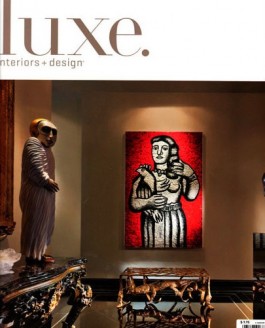
The striking urban beauty we created in an 86th floor penthouse at Trump Tower Chicago caught the attention of the Home Builders Association of Greater Chicago and resulted in our receiving a second Gold Key from the group. The same design intrigued the editors of Luxe Interiors Chicago who are featuring this residence in the Winter 2011 edition of the magazine.

This has been an amazing year for John Robert Wiltgen Design, Inc. Again, thank you one and all for your support, your referrals, and especially your friendship. Please forward this e-mail to anyone you think might be interested in receiving this information.

All of us here at John Robert Wiltgen Design wish that your world is beautiful!!!

John Robert Wiltgen, Professional Member IIDA

WHAT IS IN?

November 2nd, 2010

Dear Friends,

In regard to the world of interiors I am frequently asked….”What is in?” And, I respond with the same answer I have given for years… “Everything!”

The appropriate components of a stylish interior depend upon so many factors that the result is always different – no two homes are ever the same. Our clients and their families have specific needs. The environment may be a minimalist penthouse in a luxury high-rise building or a vintage Castello in the DePaul neighborhood or a grand walled estate in equatorial Africa. For each of these varied interiors, the furniture and furnishings we recommend to complete the design concepts are totally different.

Consider the following…

As the focal point for the gracious living room of a vintage Chicago building at 1420 N. Lake Shore Drive we selected a triptych – Les Ballets Rousses commissioned for the 1933 Chicago World’s Fair. Its framed panels feature The Firebird (based on a Russian fairytale), Le Carnaval (a ballet) and Scherezade (1001 Arabian Nights, an original ballet).

Created not long after the 1929 completion of the handsome 19 story Gold Coast structure, the fluid beauty of the art and its unique provenance make it an obvious choice. This and the gold and silver leafed mirror cocktail table, combined with a cashmere Versace blanket, and leopard stenciled fur covering the seat cushion and pillows of the antique settee give this room style and drama – the John Robert Wiltgen Design signature.

Featuring classic pre-World War II architecture, the building’s restrained; timeless façade overlooks Lake Michigan and Oak Street Beach. The building offers two spacious 4,000 square foot residences per floor. Each with a gracefully arched entrance, ornately carved moldings, four bedrooms, 4 ½ baths, and hardwood floors, a library, formal dining room, full sized laundry and a kitchen with a butler’s pantry.

Our goal for this residence was to achieve a current look referenced by the past.

We took this unprecedented opportunity to blend authentic antique furnishings and accessories with contemporary, midcentury modern pieces and an inspired collection of art (both traditional and contemporary) to achieve a fresh sophisticated mood in a refined setting.

Note our versatility in the paneled library where Laurie Hogin’s untitled fantasy of fruit and fauna adds spirited interest above an international-style love seat, establishing marked contrast with the serious countenance of a 19th century carved oak partner’s desk and period style gilt floor lamp.

Kudu horns and a stylized Etruscan vase add interest to the timeless 19th century Italian ebony and inlaid ivory console anchoring the vestibule. Located between the foyer gallery and living room, an original lithograph by Rufino Tamayo is the perfect complement to the vestibule vignette.

Fresh cut flowers on French polished, faux bois, fluted pedestals add an Elsie de Wolfe touch to the dining room. We dramatized the setting with a larger than life 19th century Frederic Leighton painting and art deco Clement Rousseau-style dining chairs featuring shagreen back panels. The scale and subject matter of the painting, The Rescue of Andromeda, and the brilliant crystal chandelier add to the room’s style and drama.

These are just a few new examples of what is “in” in the JRWD world of interiors. We are in the midst of completing several other projects which we will share with you in the near future. In the meantime, thank you for your continued interest and support of John Robert Wiltgen Design, Inc.

And we want to be among the first to wish you a Happy Thanksgiving. Yes, it will be here before we know it!!!

Sincerely,

John Robert Wiltgen, Professional Member IIDA

DINING EVOLUTION

August 20th, 2010


Dear Friends,

Hard to believe but John Robert Wiltgen Design, Inc. has now been in business for almost 30 years –three decades. Yikes!

This auspicious occasion has caused me to reflect on various events in my life and career – most of which seem to be centered in dining rooms. Mine, that is. After all, the dining room is where both the body and spirit are nourished…


My odyssey began in 1981 when I launched my professional practice and bought my first “real” home. I had been living in a small condo in Old Town when I discovered a dilapidated three flat at 1922 N. Honore. Did I say dilapidated? Look at the photo above. I plunked down $27,000 for a disaster scheduled for court-ordered demolition. It was located in what my friend, Bill Senne, would later christen Bucktown, USA, though the area had not yet experienced the gentrification that would transform it into one of Chicago’s trendiest “hoods.’’  But hey! Chalk outlines on the sidewalks – it was going to be home and, as a designer, I was supposed to have the vision to see what it could become. Picture me in cut-off jeans lugging drywall up two flights of stairs and then installing it with a high school friend I had coerced to assist in the task. To speed up the process I hosted an ultra chic  “Bring Your Own Crowbar’’  party on the rooftop and served gourmet hot dogs and beer! It put a few holes in my roof – the casualties of war!


My first dining room! An English Regency table and chairs that traveled with me to several other locations held center stage. I felt the backbreaking work had accomplished its purpose when Pat Gerlach, then editor of the Daily Herald Home & Garden  section, wrote about my home. Pat subsequently followed my career and later became my publicist, a task that keeps her from harassing other designers.


Within three years I left Honore Street for new digs located immediately behind the Belmont Hotel. My new building included a six car garage I counted on being demolished by one of the hotel’s supply trucks that had to turn the corner of the alley. No such luck! But my new dining room – again showcasing the Regency table and chairs – was completed just in time for Christmas. After remodeling all of the kitchens and baths in the building, sanding the hardwood floors, and painting, it was time to decorate with holiday trees. Two in the dining room.  Another in the living room, along with a reindeer head on the fireplace mantel! But my favorite element in that dining room was the stylized Neo-classic painting I found at the Chicago Rozmallin showroom – a now defunct  utterly gorgeous source I sorely miss. But back to the painting – I posed proudly beside it for a holiday story. That was obviously before Versace assumed command of my wardrobe.


By the end of the 80s I reasoned the Gold Coast was finally ready for me. I still cherished the Regency dining chairs but moved the table to our warehouse until I had it completely refinished for use in one of the five (5) model homes we created at The Condominium Residences at Chicago Place. I designed a new more free form stone topped table and sold versions of it through the elegant Rozmallin Showroom. In this era I began collecting Egyptian art work; the circa 1820s prints became the framework for this dining room’s decoration.  The prints came from books published soon after Napoleon’s military conquest of Egypt. Antique, hand carved, Rosewood candle holders in the likeness of cobra’s I still use today!


The 1990′s marked my return to Bucktown in a six flat I remodeled into three large apartments, once again performing most of the demo work myself. Can you believe that?  My now signature Regency dining chairs came along but this time bellied up to a new crackle finish extension table I particularly liked. The room was anchored by a Santos mahogany floor; the natural color was so beautiful. The draperies were leather hides tossed (literally) over dramatic black iron rods with curled finials. An antique chandelier, purchased from my friend Jim Neuman at New Metalcrafts, was tantamount to a piece of hanging sculpture. I still have this lovely light fixture today.  I honored the setting with a framed photograph of my dear friend Lara posing in front of the doorway to her home in Brussels; though she has lived all around the world, she has never forgotten me. I’ve used the same photo in numerous model homes I’ve designed throughout the city and today keep it in my own dressing room.


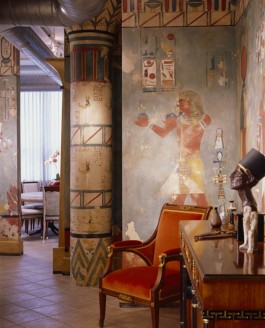
My current Egyptian Temple is another story altogether. In the late 1990′s we created the models for Metropolitan Place,the condominium conversion of the Florsheim Shoe Factory and Corporate Headquarters. I was mesmerized by the capitals on its concrete columns which reminded me of lotus leaf details at the Temple of Luxor. They became my inspiration for transforming this home to reflect all things Egyptian. By this time I had acquired a reasonable collection of antiquity including some excellent examples of Roman glass, Attica pottery and Egyptian artifacts. My faithful Regency chairs, crackle finished dining table and antique chandelier made the move with me. They have served me well.


But now my dining room has entered the 21st century. The Regency chairs are gone; so is the crackle top extension table that I purchased for my third building in Bucktown. The chandelier is ensconced elsewhere in my home. The metamorphosis came after a study trip to Venice and Northern Italy – an opportunity for me to become more intimate with the work of my favorite architect and muse, Andrea Palladio. Once back home, I immediately  ordered walls that had been left blank filled with the heiroglypics which already covered the gallery and kitchen. As you all know, I believe you can NEVER have enough hieroglyphs in your home!

This has been an amazing year for John Robert Wiltgen Design, Inc. Thank you one and all for your support, your referrals, and especially your friendship. And, please forward this e-mail to anyone you think might be interested in receiving this information.  


 John Robert Wiltgen, Professional Member IIDA